
Darconville's Cat: Chapter 76
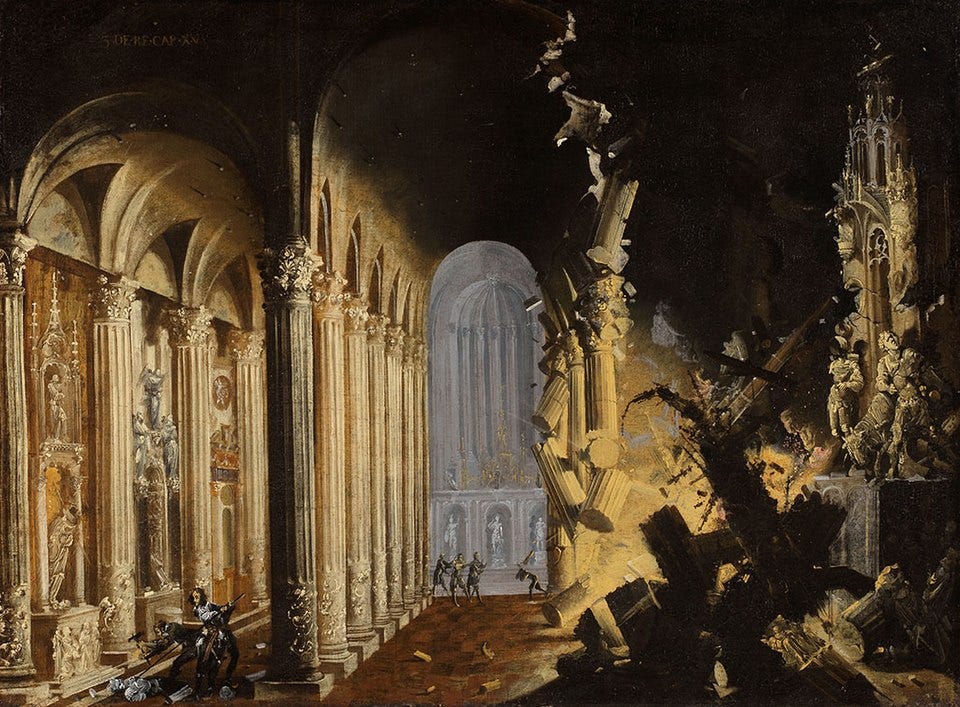
Abomination of Desolation

Summary
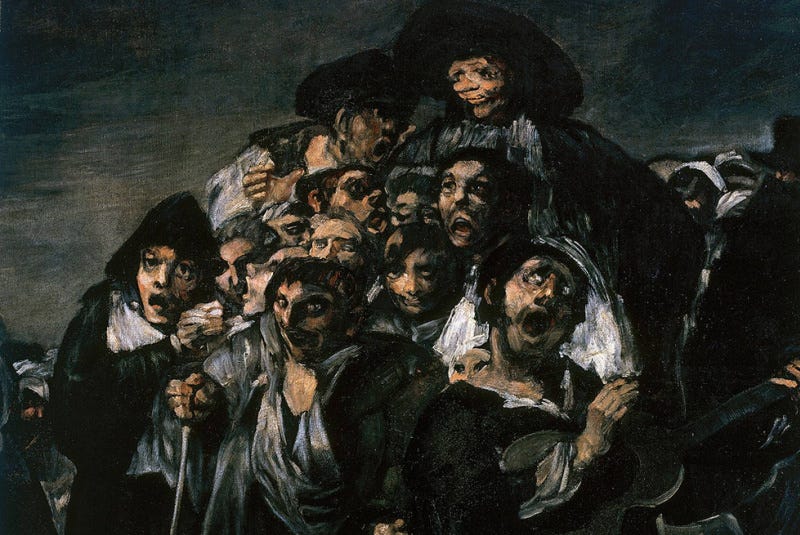
Chapter LXXVI functions as Alaric Darconville’s linguistic scorched-earth policy, and as a rhetorical katabasis – a descent into the underworld of pure invective. Stripped of his romantic delusions, the jilted scholar retreats into the role of a crazed Old Testament prophet to unleash a single, sustained paragraph of unhinged maledictions upon Fawx’s Mt. Rhetorically, this functions as isocolon or sustentation, which is the deliberate accumulation of clauses to create an overwhelming, “breathless” effect. Structurally, this marks the shift from Darconville as a “Man of Letters” to Darconville as a “Man of Malice”, thoroughly poisoned by Crucifer’s diatribes. Rather than processing his rejection by Isabel Rawsthorne with any psychological maturity, Darconville attempts to literally curse her zip code into oblivion. Utilizing a maximalist, Rabelaisian style, Theroux constructs a single-paragraph malediction, weaponizing the apocalyptic prose of Aleister Crowley, Djuna Barnes, and the Bible to call down a plague of hunchbacks, locusts, and demons upon the Virginia backwoods. It might have also been inspired by Ernulphus’ excommunication in Tristram Shandy (Vol. III, Ch. 11, SM). This brief, powerful chapter functions as a cathartic, albeit terrifying, verbal exorcism of Darconville’s unbearable pain, transforming his personal agony into a cosmic condemnation and marking his definitive descent into a state of profound desolation and rage. His erudition is no longer used to enlighten, but to annihilate.
Annotations:
Page 507
507.title] Abomination of Desolation: A phrase originating in the Book of Daniel (shiqquts meshomem) and echoed by Christ in the Olivet Discourse (Matthew 24:15). While it historically refers to the “appalling sacrilege” of Antiochus IV Epiphanes profaning the Jerusalem Temple with an altar to Zeus, Theroux employs it here as a typological inversion. Darconville views his own aesthetic and romantic devotion as a “Holy of Holies”; Isabel’s rejection is thus not merely a breakup, but an act of cosmic desecration. Yet this title functions as a deliberate callback to an earlier flight in the novel. On page 167, the protagonist speeds away from the Fawx’s Mt. with Isabel, feeling as if “the Abomination of Desolation itself” lay behind them. This earlier usage reveals Darconville’s proleptic (forward-looking) hatred; his “sacred” love for Isabel was always predicated on his “sacred” hatred for her origins. By returning to this phrase, Theroux suggests that Darconville’s grief is essentially circular: he has arrived back at a theological prejudice he had been drafting all along, officially rendering the site a desolate monument to his ruined ego.
507.epigraph] A great horror and darkness fell upon Christian. – JOHN BUNYAN: This is a direct reference to the final trial in Part I of The Pilgrim’s Progress (1678), as Christian crosses the River of Death. By selecting this moment, Theroux frames Darconville’s “Abomination” as a “limit-experience”, a point of no return. The phrase itself is an allusion to Genesis 15:12, describing the “horror of great darkness” that fell upon Abraham during the “Covenant of the Pieces.” This biblical context is significant: that covenant involved the ritualistic slaughter and bisection of animals, a graphic precursor to the “linguistic butchery” Darconville performs in the following paragraph, and further heightened by Crucifer in the next 160 pages. In a scholarly sense, this epigraph creates a parodic hagiography; Darconville casts himself as a suffering saint (Christian) or a patriarch (Abraham), yet unlike his models, he seeks not God’s grace, but the power of the Great Anathema1. The “horror” is not the absence of God, but the presence of an ego that refuses to be humbled.
507.1-2] THE LAST SIGHT of Fawx’s Mt. became too much to bear, and Darconville cried out terribly upon it.: This sentence functions as the narrative “fuse” for the subsequent malediction. Academically, this moment represents the psycho-geographic collapse of the novel’s setting. Fawx’s Mt. is no longer a physical location but a symbolic topography upon which Darconville projects his internal “Abomination.” His theatrical agony here is not merely narcissistic, it prepares the reader for a ritualized performance. By “crying out terribly,” Darconville assumes the persona of the Maledictor, a figure found in the satires of Archilochus or the polemics of Milton, where linguistic violence is treated as a substitute for physical action. The Menippean irony is inescapable. Fawx’s Mt. is simply a dreary cluster of provincial houses, yet Darconville addresses it as if it were a locus of world-historical evil.
507.2-4] May it be cursed forever! May it wither into the grin of the dead! May flowers and children die in its shadow! May the birds of the air refuse to fly over it!: Darconville’s descent into apocalyptic rage is heavily subsidized by modernist and occult literature. The phrase “wither into the grin of the dead” is sourced from Djuna Barnes’s Nightwood (1936), specifically the “Watchman” chapter. This links Darconville to the Modernist Gothic tradition, where language is used to express the “un-nameable” despair of the social outcast. He then supplements this modernist gloom by plundering Aleister Crowley’s preface to The World’s Tragedy for the curse regarding the birds of the air. This adds a layer of Thelemic or “Black” hermeticism. Crowley’s work was a vitriolic attack on Christianity; by using it, Darconville is effectively “excommunicating” Fawx’s Mt. from the realm of the sacred. Even in his state of raw, unbridled rage, Darconville remains a pedant. His inability to speak “from the heart” without the aid of Barnes or Crowley suggests that his grief is performative, it is a literary construction. This underscores a central theme of the novel: the danger of living a life that is “read” rather than “lived.” The curse is not a spontaneous outburst but a scholarly excavation of previous despairs.
507.4-6] May it henceforth stand a desert of recrimination, spawning hunchbacks to eat ashes for bread and to mingle tears with drink!: Darconville invokes the punitive landscaping of the Old Testament to redesign his ex-fiancée’s hometown. The phrase “eat ashes for bread and to mingle tears with drink” is a direct lift from Psalm 102:9. In the Catholic tradition, this is one of the Seven Penitential Psalms. By using it as a curse, Darconville is committing a “rhetorical sacrilege”, i.e. turning a prayer for personal repentance into a weapon of external vengeance. The “spawning [of] hunchbacks” connects to the study of monsters and physical deformity (teratology). This links back to the novel’s earlier obsession with the “grotesque” (such as Isabel’s uncle) and suggests that Darconville views moral failure as a biological contagion that should manifest physically. This is a classic Fisher King inversion. Usually, the land is healed when the hero is cured; here, the hero is so wounded that he demands the land be rendered permanently sterile.
507.6-8] May Satan pinch into the faces of its inhabitants the pain of hell that by them it be sown with salt and continue ever an abomination to sight!: The image of Satan “pinching” pain into faces suggests a demonic parody of God “forming” man from clay (Genesis 2:7); here, the inhabitants are re-sculpted into icons of agony. The command that the land be “sown with salt” is a reference to the ritual of Herem (total devotion to destruction), most notably performed by Abimelech against the city of Shechem in Judges 9:45. While this practice is often associated with the Roman destruction of Carthage, the biblical context might be more pertinent to Darconville’s theological rage. By “sowing with salt,” he seeks a hermetically sealed sterility, ensuring that nothing “Isabelline” can ever grow there again. Finally, declaring the site an “abomination to sight” invokes the aesthetic of disgust (cf. Aurel Kolnai, “On Disgust”); he wishes to render Fawx’s Mt. visually “unconsumable,” effectively erasing it from the world of the beautiful.
507.8-11] May the maiden that passes it become barren and the pregnant woman that beholds it abort! May its crops be given to the caterpillar and the fruits of its labor to the locust!: Darconville here enacts an anti-natalist liturgy, systematically revoking the “Be fruitful and multiply” mandate of Genesis. His curse on the womb mirrors the prophetic invective of Hosea 9:14, while his call for “caterpillars and locusts” adopts Psalm 78:46 (SM). Academically, this represents a transition from personal grief to Manichaean spite, an ideology likely fueled by the influence of his demonic mentor, Crucifer. By targeting both human reproduction and agricultural yield, Darconville seeks to create a biological vacuum. In the tradition of the gothic anti-pastoral, the landscape is punished for the perceived “sin” of the beloved. The “beholding” of the land causing abortion suggests a malignant optics: the environment itself has become so toxic that merely looking at it is fatal to life.
507.11-508.2] May the winged monsters be reaved out of the infernal pit to dwell therein and demons sit high forever in its rebarbative trees to scourge it in satire and song!: This passage articulates Darconville’s ultimate fantasy: the transformation of literary criticism into a literal demonic haunting. The use of “rebarbative” (from the French barbe, or “beard”) suggests a landscape that is “bristling” with hostility. The image of demons “scourging”2 the town in “satire and song” refers to the classical tradition of Archilochian invective, where poetry was considered a lethal weapon capable of inducing madness or death in its subjects: Archilochus apparently wrote satires so potent that his targets (Neobule3 and her family) hanged themselves. Darconville is wishing for an “Archilochian” landscape where the very trees sing songs of suicide. Darconville is delegating his own rhetorical agency to “winged monsters,” suggesting that his rage is so vast it requires a supernatural choir to sustain it. Darconville doesn’t want the town to burn; he wants it to be mocked into non-existence by a “scourge” of perpetual, demonic footnotes.
Page 508:
508.2-5] May the light of the sun be withheld therefrom and the light of the moon be hidden from it forevermore, with accursedness its perpetual condition and doom its eternal reward!: The malediction concludes with a final, systematic act of De-creation. By calling for the withdrawal of solar and lunar light, Darconville rhetorically reverses the creation narrative of Genesis 1:14-19. The first part is again plundered from the “Preface” to Aleister Crowley’s The World’s Tragedy (1910). Crowley’s text was an explicit “declaration of war” against the Christian ethos. By adopting Crowley’s phrasing, Darconville, formerly a champion of Catholic order, formally defects to the side of the adversarial occult. The terms “perpetual condition” and “eternal reward” are linguistic parodies of the Nicene Creed and Catholic liturgy, which usually assign “life everlasting” as a reward. Darconville performs an inverted doxology, sentencing Fawx’s Mt. to the “outer darkness” (Matthew 8:12). Chapter LXXVI is almost entirely a cento, i.e. a composition made of fragments from other texts (Barnes, Crowley, Bunyan, the Bible). This stylistic choice suggests that Darconville’s “scorched earth” policy has left even his own mind a wasteland. His rage is not “raw”, it is encyclopedic; he can only speak as a composite of his library.
Vocabulary
507
Abomination of Desolation: (Biblical) A phrase originating in the Book of Daniel and later used in the Gospels of Matthew and Mark to describe the ultimate sacrilege or desecration of the Holy Place; here, it signifies the total spiritual and physical ruin Darconville wishes upon the “corrupted” sanctuary of Fawx’s Mt.
recrimination: (Latin re- “back” + criminari “to accuse”) An accusation in response to one from someone else; a state of mutual, bitter blaming.
spawning: (Old French espandre “to shed or spill”) Releasing or producing offspring; often used pejoratively.
reaved: (Old English reafian) Plundered, robbed, or violently snatched and torn away.
508
rebarbative: (French rébarbatif, from barbe “beard,” suggesting a bristling, hostile confrontation) Unattractive, objectionable, and forbidding; grim or harsh in appearance.
scourge: (Latin excoriare “to flay”) To punish, whip, or cause great suffering and destruction; used here to describe the demonic torment of the landscape.
Next chapter:

A formal ecclesiastical curse involving excommunication. In the Early Church, an anathema was the “devoting” of a person or place to destruction. Darconville is performing a secularized version of this rite, attempting to use his “priestly” authority as a scholar to “devote” the Virginia landscape to total annihilation.
In the 17th and 18th centuries, satire was frequently referred to as a “scourge” or flagellum.
Neobule is also mentioned in the Misogynist’s Library, cf. 448.13.
The curse may also have been inspired by the famous bilingual curse in <Tristram Shandy,> vol. 3, chap. 11 (technically an excommunication).
507.11: May its crops be given to the caterpillar and the fruits of its labor to the locust: cf. Psalm 74:46: "He [Yahweh] gave their crops to the caterpillar; the fruit of their labor to the locust."